

The Tactile Wall Art Project — Tactile Art Exhibition Darwin

How an Artwork Evolves Through Play, People and Place
An artwork does not always have to stay still.
Some artworks can be touched, rearranged, rebuilt and reconsidered. They can change as different people encounter them.
That idea sits at the heart of my Tactile Wall Art Project, which will culminate in a series of workshops and an evolving exhibition at UNTiTLED gallery+studio in Darwin from 28 October to 19 November 2026.
The Tactile Wall Art Project is a tactile art exhibition in Darwin that brings together workshops, interactive installation, sculpture, drawing and creative play.
The project brings together tactile art, drawing, sculpture, imaginative play and creative learning. But perhaps most importantly, it asks what can happen when an exhibition is treated not simply as a finished display, but as a living creative environment.
Tactile Art Exhibition Darwin: An Installation That Evolves
The beginnings of this project can be seen in an installation I first developed while studying art.
I worked with everyday and recyclable materials — pieces of wood, fabric, wool, cardboard, found objects, drawings and small sculptural forms — arranging them across the wall and surrounding space.
Children could encounter materials at different heights and in different ways. Objects might be touched, moved, combined or interpreted. Drawings could sit beside three-dimensional forms. Something made from cardboard might suddenly suggest a creature, a building or an entirely different story.
Later, when I installed the concept for a final exhibition at the Academy of the Arts, the work looked different again.
The idea had remained, but the artwork had evolved.
That distinction has become increasingly important to me.
The Tactile Wall Art Project is not about recreating one installation exactly as it existed before. Each new version responds to the space, materials and people who enter it.

Early tactile wall installation developed during my university studio practice.

A later exhibition installation of the same evolving concept.
The same creative idea in two different settings. The materials, arrangement and visual language change as the project responds to a new space and new participants.
From tactile play to artistic ideas
The process often begins very simply.
A child might pick up a piece of fabric.
Another might balance two pieces of wood.
Someone might wrap wool around an object, arrange a collection of forms, or discover that two unrelated materials suddenly look like the eyes of a creature.
These constructions do not need to become permanent sculptures.
I call them ephemeral sculptures — temporary arrangements that can be made, changed, dismantled and made again.
The value is in the process.
A temporary sculpture can then inspire a drawing. A drawing may become a character. The character might lead to a painting, story, mask or larger sculptural idea.
I sometimes describe the strange and experimental beings that emerge from this process as avant-garde creatures: unconventional characters that grow from materials, imagination and individual choices rather than from a prescribed model.
Children are not being asked to make my creature.
They are discovering their own.
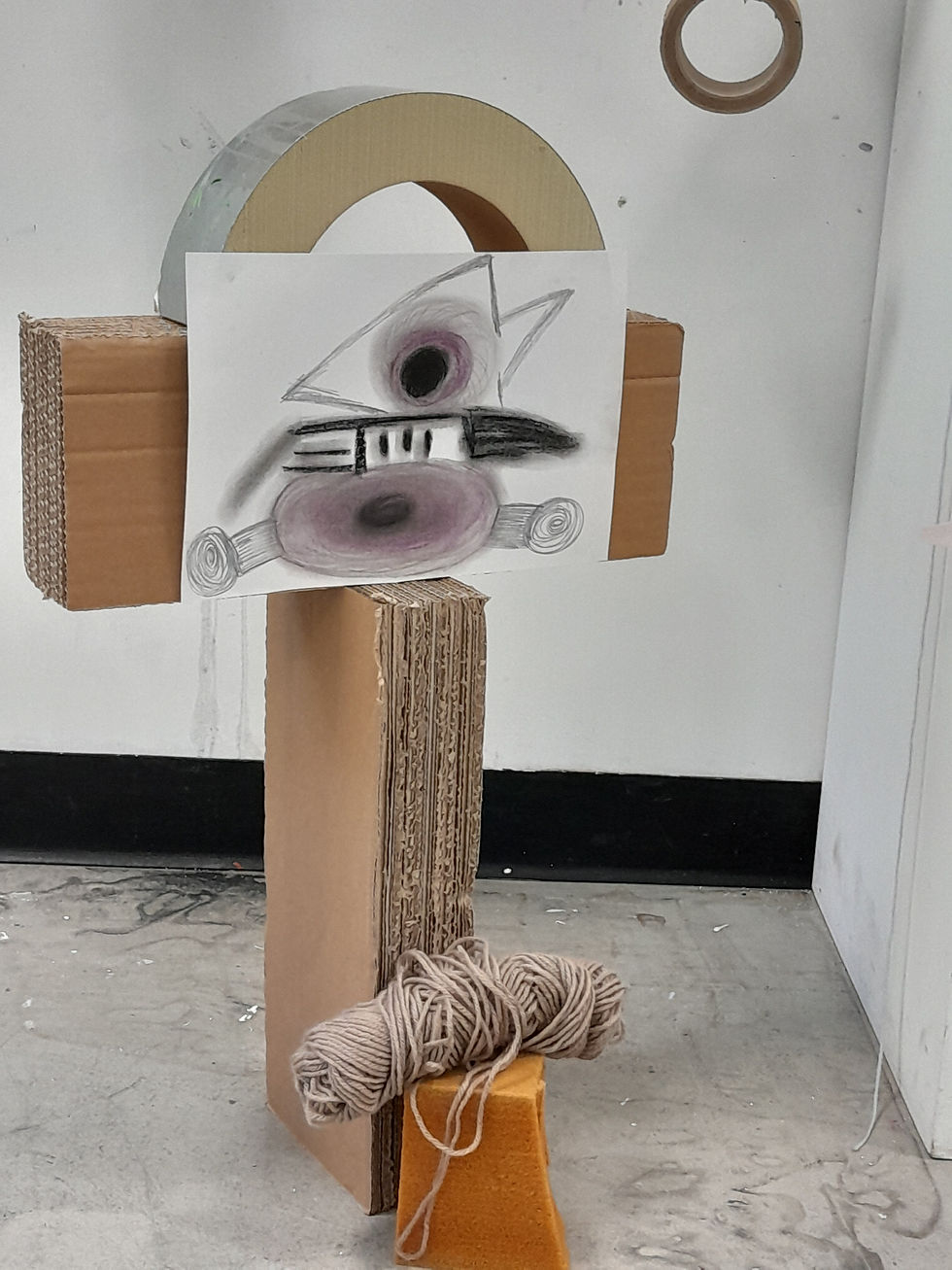
PlayArt: making, changing and rebuilding
An important part of the exhibition will be a designated interactive PlayArt area.
Children and families will be able to work with selected materials and create temporary sculptures in response to the exhibition.
Not everything in the gallery will be touchable. Some artworks and installations will remain for viewing, while particular areas and materials will invite interaction.
Within the PlayArt space, however, changing the work is part of the experience.
Build something.
Look at it.
Change it.
Take part of it away.
Add something unexpected.
Begin again.
This repeated process of making and remaking allows children to experience art as something active rather than fixed.
It also means that the exhibition people encounter on one day may not be quite the same exhibition they encounter when they return.
The participants are already changing the project
Something interesting has already begun to happen.
When I initially developed the 2026 workshop program, I imagined distinct groups: children, teenagers, and parents or educators.
Then the enrolments began arriving.
Families expressed interest. Older children enrolled. Younger teenagers were interested. Adults and educators joined the project.
Instead of forcing those participants into categories that no longer quite fitted the reality of the group, I began adapting the program.
The second workshop has therefore evolved into a Youth Workshop for older children and younger teens.
In a way, this feels completely appropriate.
The exhibition is built around responsiveness, experimentation and change — and now the structure of the project itself is responding to the people who are coming.
The participants are already influencing the exhibition before we have even entered the gallery.
I love that.
It reminds me that participatory art is not simply about inviting people into something I have already decided. It also requires me, as the artist and facilitator, to observe what is happening and allow the project to grow.
A shared creative environment
My approach to the project comes from two interconnected parts of my life: my studio practice as an artist and my long experience as a teacher.
I have taught for more than 25 years across the Northern Territory and overseas, including work in Germany, the United Kingdom and Spain. My educational practice has also been influenced by Montessori and Steiner approaches.
Those experiences have shaped the way I think about creative environments.
I am interested in giving people enough structure to feel secure while leaving enough openness for genuine discovery.
Materials are therefore carefully selected and prepared, but there is no single required outcome.
An adult and a child might respond to exactly the same object in completely different ways.
An older child may construct something complex and architectural.
A younger participant may be fascinated primarily by texture or colour.
An educator might begin thinking about how a similar process could be adapted for a classroom.
Each response is valid.
Why touch matters

We often experience art primarily through our eyes, particularly within galleries.
But artistic understanding can also begin through the body.
We learn about an object by holding it.
We notice weight.
Temperature.
Texture.
Resistance.
Balance.
Softness and hardness.
We discover whether something bends, rolls, stacks, wraps or falls.
These physical encounters can lead to visual and imaginative ideas.
For children especially, sensory exploration can provide an immediate way into creative thinking before they have the vocabulary to explain what they are discovering.
The tactile experience is therefore not an extra activity attached to the art.
It is part of the artistic process itself.
An exhibition that grows over time
The 2026 exhibition will continue this idea of evolution.
Participants from the workshops will contribute work and ideas. Selected pieces will enter the exhibition environment. Interactive areas will continue to change. Visitors will encounter traces of what previous participants have made.
There will also be opportunities for workshop participants to return through small mini-openings, allowing them to see how the space has developed since their original session.
For me, that return is important.
A participant does not simply make something and leave.
They can come back and discover:
What happened next?
What did somebody else add?
What changed?
How does my work look when it becomes part of something larger?
The exhibition therefore becomes partly an artwork and partly a record of a creative community forming over time.
Tactile Art Exhibition Darwin — 2026 Program
UNTiTLED gallery+studio | Coconut Grove, Darwin
28 October–19 November 2026
Children’s Workshop — Ages 6–12
Wednesday 28 October4:30–6:30 pm
Exhibition Opening
Saturday 31 October10:00 am–12:00 pm
Youth Workshop — Older Children & Younger TeensTuesday 3 November4:30–6:30 pm
Youth Mini-Opening
Saturday 7 November
An opportunity to return to the exhibition, see how it has evolved, interact with the installation and continue creating.
Parent, Caregiver & Educator Workshop
Tuesday 10 November4:30–6:30 pm
Parent/Educator Mini-Opening
Saturday 14 November
An opportunity to revisit the evolving exhibition, continue making and respond to the work as it develops.
Final Exhibition Day
Thursday 19 November
A project that continues beyond the gallery
Participants will also receive creative resources designed to help the exploration continue beyond the workshop.
This matters to me because the project is not really about producing one object during a two-hour session.
It is about introducing a process:
notice → touch → arrange → imagine → draw → change → make again
Once children understand that process, it can continue almost anywhere.
A collection of recycled cardboard can become sculpture.
A piece of bark can suggest a drawing.
A shape can become a creature.
A creature can become a story.
Creativity does not have to begin with expensive materials or a perfect idea.
Sometimes it begins simply with permission to experiment.
Creativity begins with the courage to play
The Tactile Wall Art Project continues to change as I prepare for the exhibition.
And I expect it will continue changing once the doors open.
That is not a problem to solve.
It is the point.
The installations I created previously were never identical. Different spaces changed them. Different materials changed them. And now a new group of children, young people, adults, parents and educators will change the work again.
I can establish the environment.
I can prepare the materials.
I can introduce possibilities.
But I cannot know exactly what everyone will make.
And that uncertainty is one of the things I find most exciting.
At its heart, the Tactile Wall Art Project is an invitation to explore art not simply as a finished product, but as a process of discovery — one that grows through curiosity, connection and the courage to play.
Watch the Tactile Wall Art Project
Watch a short film exploring the ideas, materials and creative process behind the Tactile Wall Art Project.
The Tactile Wall Art Project is proudly supported by:

From Tactile Art to Artist-Designed Clothing

From tactile experiment to painting to clothing — these designs continue the same creative process a 
From tactile experiment to painting to clothing — these designs continue the same creative process a 
From tactile experiment to painting to clothing — these designs continue the same creative process a 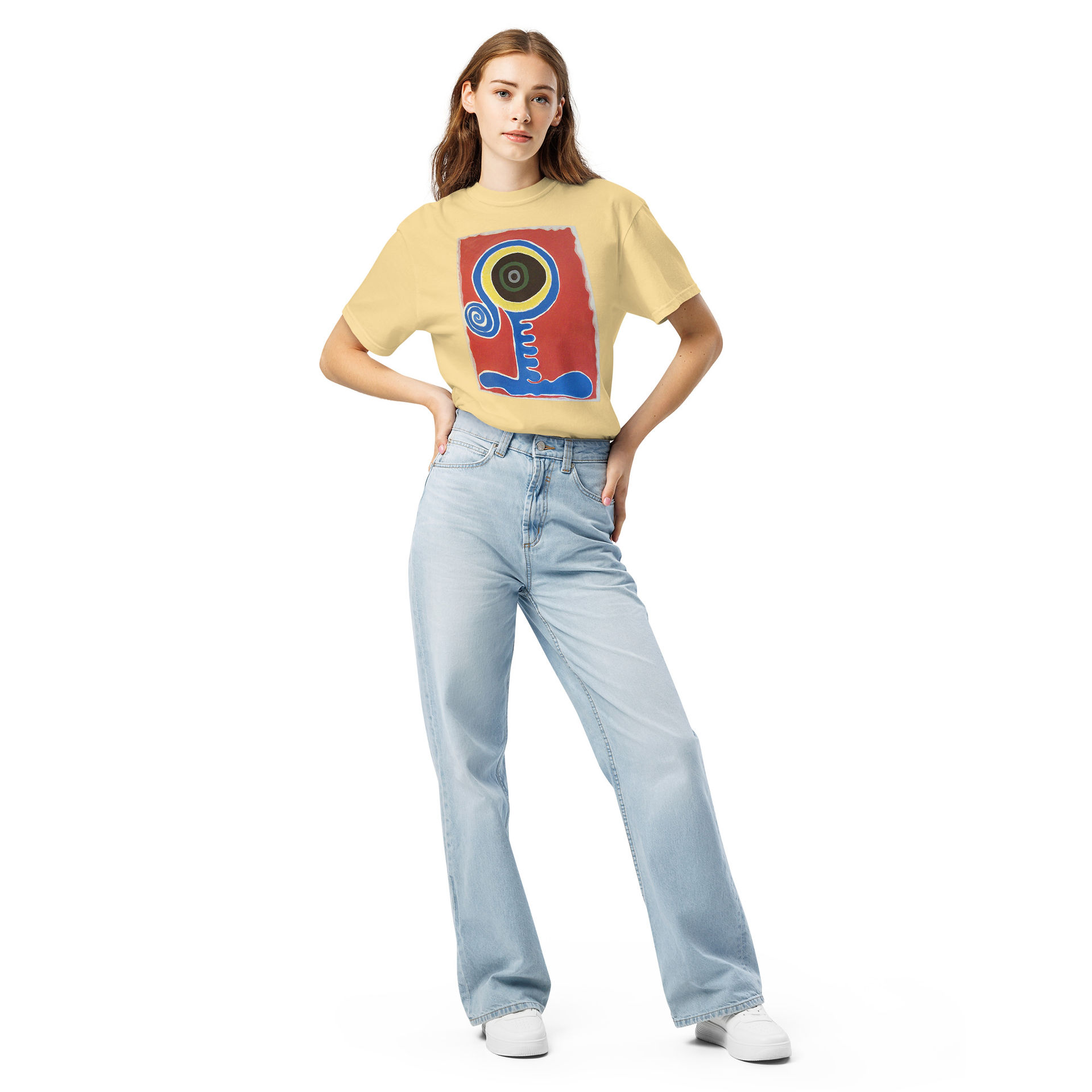
From tactile experiment to painting to clothing — these designs continue the same creative process a
The same process of experimentation that shaped the Tactile Wall Art Project has also moved into my artist-designed clothing.
These designs grow from paintings and character studies created through the project’s tactile, process-led approach — working with colour, line, texture, found forms and imagination, then translating those ideas into another medium.
Here, the artwork moves from installation and painting into clothing designed to be worn.
Selected pieces from this evolving collection are now available online through Maria Grujicic Studio.
I am continuing to develop the collection, and I hope to explore the connection between tactile art, creative process and artist-designed clothing more fully in a future issue of Studio Magazine.
© 2026 Maria Grujicic Studio. Tactile Wall Art Project concept, original artwork and artist-designed clothing by Maria Grujicic. All rights reserved.


Comments